
14/April
Safe Water Secret With Zeolite For Water Filtration
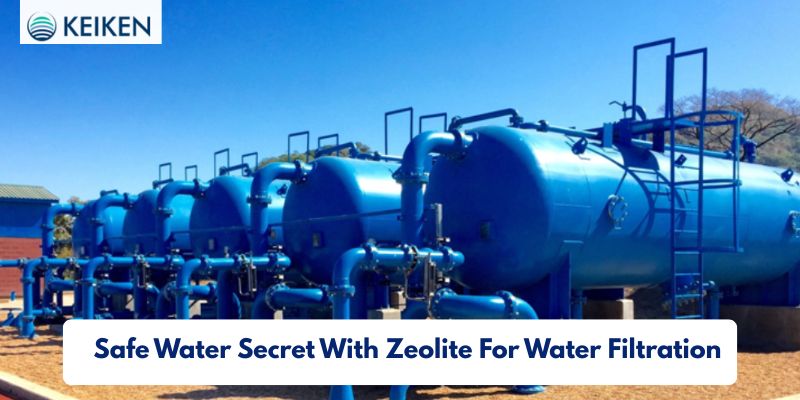
Clean water influences a healthy lifestyle. In the contemporary world, many families are experiencing problems such as poor taste, odor, hardness and concealed impurities in their water, which thus drive them to consider improved filtration methods. Using zeolite to filter water is still being considered. It provides a simple, efficient and environmentally friendly method for enhancing water quality without complex systems or intensive chemical use.
Zeolite does not operate in the same way as conventional filtration media. It not only acts as a filter but also reacts with contaminants. The special feature makes it an intelligent option for homes and the light industry. Let’s delve into zeolite filtration performance in a real-world setting.
Table of Contents
- Does zeolite for water filtration upgrade the taste and odor?
- How long does the zeolite filter water before replacement?
- Is zeolite for water filtration worthy for tap water or a borewell?
- Which contaminants does the zeolite remove?
- Is it possible to reuse zeolite for water filtration at home?
Does zeolite for water filtration upgrade the taste and odor?
Yes, using zeolite for water filtration is a great way to enhance the taste and odor. Ammonia, organic matter and dissolved metals contribute to many bad smells in water. Water containing such impurities has a metallic or stale taste, therefore making it difficult to drink. With zeolite, you can actually eliminate these contaminants through ion exchange and adsorption.
Zeolite traps undesirable particles and exchanges undesirable ions for more desirable ones, thus producing clean, fresh, and palatable drinking water. Where the primary source of water is borewell water, you may notice a very quick increase in the smell and taste following the application of zeolite. This feature makes it extremely convenient for meeting daily drinking water needs.
How long does the zeolite filter water before replacement?
The zeolite life cycle in the filtration process is dependent on its usage frequency, the quality of the water being treated, and how well the zeolite is maintained (washed/renewed). According to standard household use, zeolite can be expected to last anywhere from two to six months. You can clean or backwash the filter now and then to remove trapped particles. This procedure restores the flow's efficiency and maintains the smooth operation of the filtration system.
Compared to most alternative conventional filter media, zeolite is more resilient. Its design is also resistant to clogging, allowing it to maintain a constant flow rate. But as the ion exchange capacity decreases, there is a need to replace the ion to achieve optimal output.
Is zeolite for water filtration worthy for tap water or a borewell?
Zeolite for water filtration is efficient at removing impurities from both tap and borewell water, making it important for household use. The water in the borewells tends to be either very hard or contains a lot of ammonia, iron, and other mineral salts. Zeolite helps reduce these contaminants and enhances the overall quality of water. It may also help soften the water by reducing the mineral content. In the case of tap water, zeolite is in usage as an added filter. It eliminates the remaining contaminants, increases clarity and taste.
Although municipal water treatment systems are already in place, they may not remove all impurities. Zeolite bridges the gap with an additional level of filtration. Because of this twofold capability, many homeowners opt to use zeolite in a multi-stage filtration system. It is flexible to various water conditions and provides consistent results. Water functions as a social level of attraction. Aside from zeolite, carbon filtration is also suitable as an alternative. To achieve a more detailed insight, you can check out (Filtering The Posterity: Activated Carbon For Treating Water).
Which contaminants does the zeolite remove?
Zeolites used to filter water can eliminate most contaminants. It is a strong filtration medium as its structure enables it to entrap particles and to exchange harmful ions. Here is the list of contaminants that zeolite pertinently removes:
- Ammonium and ammonia ions
- Lead, iron and copper are heavy metals
- Nitrates and phosphates
- Suspended solids and fine particles
- Organic compounds and a few hydrocarbons
Such a wide-ranging removal capacity makes zeolite applicable for both domestic and industrial use. Zeolite increases water safety, clarity and usability.
Is it possible to reuse zeolite for water filtration at home?
It is possible to regenerate zeolite by performing a simple salt rinse, after which it can be used for water filtration. The salt also helps restore its ion-exchange capacity, thereby removing trapped contaminants. As a home user, you can carry out basic regeneration provided the contamination levels are moderate. Although zeolite will initially cost less than single-use filters, its regeneration rate will eventually decrease. Ultimately, the zeolite pores will no longer effectively retain contaminants. With proper care and maintenance, it can be used for longer.
Bottom Line
The water filtration zeolite offers an excellent solution for both natural and high-performance applications. It eliminates unwanted pollutants, enhances flavor and smell and fits various water sources. Keiken Engineering offers a cost-effective solution with zeolite water filtration.
Thus, what are you waiting for? Contact us immediately at info@keiken.es or choose us. Zeolite offers a smart, sustainable alternative to more complex systems that households can install to improve their water quality. It has been gaining popularity due to its ability to meet current demands without being environmentally irresponsible.
FAQs
1. Can zeolite be suitable for drinking water?
Yes, properly treated zeolite is safe and is extensively in use in filtration systems.
2. Is zeolite able to substitute other forms of filtration?
Zeolite is in use in conjunction with systems such as RO or carbon filters, but in some cases, it does not entirely replace them.
3. Is zeolite a water softening agent?
Yes, zeolite can be used to remove some hardness minerals through ion exchange.