
02/July
The Role Of Containerised Desalination In Remote Areas
Back in the 1900s, when people mostly drank, diseases like typhoid and cholera were spreading like fire. Every ten people died due to a lack of water treatment. However, it was only around the 1950s and 1970s that governments started to focus on reliable containerised desalination systems for clean water production. During this process, the water chlorination and filtration ensured that the water is safe to drink. Ever since, governments have taken steps, both big and small, to ensure that local water bodies are clean enough to alleviate water scarcity, especially in rural areas.
There is no doubt that water is a basic human necessity. However, the sad part is that even today, many remote areas around the world still lack access to clean, drinkable water. This is where water desalination plants, designed by Keikin Engineering, come in.
In today’s blog, we will discuss these plants in more detail and explore how they are an effective way to convert dirty and salty water into clean water. Keep reading to know more.
But first, let us understand…
What is a Containerised Desalination Plant?
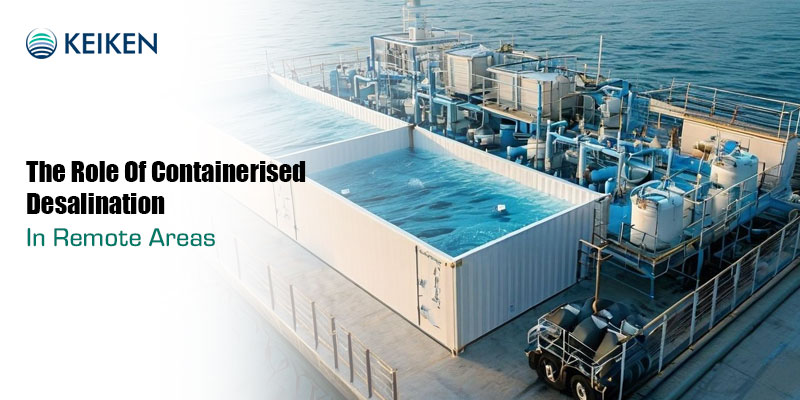
In simple terms, a compact containerised desalination plant for remote locations is housed within a standard shipping container. It removes salt and other impurities from seawater or brackish water, making it safe for both human consumption and industrial use. These plants' significant features include Reverse osmosis (RO) membranes, Pre-treatment filters, Pumps, and electrical systems, as well as remote monitoring controls. The process is simple and delivered as a turnkey solution, allowing you to obtain clean water by simply connecting the plant to the water source, and voilà! Clean and drinkable water is here.
How It Works in Remote Areas
You may already be aware that remote areas often lack the necessary infrastructure for traditional water treatment plants. Finding pipelines, stable power and expert technicians to purify the water is a challenging task. And that’s where containerised systems come in.
Let the following points explain how it works in remote areas:
- These desalination plants are delivered by truck, ship or even helicopter to rugged terrains.
- It features a quick setup and minimal installation, making it easy to use. Just plug and play.
- These plants are mostly solar-powered. But you can also opt for hybrid options for off-grid use.
- You only need minimal manpower for operation and maintenance
- It works with seawater, river water or even groundwater.
(Also read from our previous blogs: A Step-by-Step Guide to How a Containerised Desalination Plant Works)
Key Benefits of Containerised Desalination Systems
Here are some of the benefits of Portable desalination plants for clean water anywhere that are gaining popularity:
Portability
These plants are transportable across long distances and can be moved as needed. In fact, this is ideal for temporary or rotating use across multiple areas in a remote location.
Quick Installation
Containerised plants are pre-fabricated and tested before delivery, so you don’t need major construction or civil work to install these plants.
Reliable Operation
They offer reliable operation with advanced filtration and desalination technology. This means continuous clean water production with minimal downtime in rural areas.
Eco-Friendly Options
They are mostly solar-powered or energy-efficient. This is best for reducing the need to bottle or transport water over long distances.
Low Maintenance
And, finally, it also features automated systems for remote monitoring. Easy to use with minimal training, no need for considerable manpower to operate or desalinate seawater.
What features must your Portable Desalination System offer?
The following are the features you must look for when you are investing in a portable desalination system for remote areas:
1. Compact and Containerised
The plant fits in a standard shipping container for easy transport. Perfect for remote, rugged or off-grid locations. No need for permanent construction or space, just focus on cleaning water, not the installation process.
2. Quick Setup and Plug-and-Play
Legitimate and operational plants, such as Keikin Engineering’s. Our plants are fully assembled and tested before delivery. Just connect the power and water inlet, and it’s operational within hours of arrival on site.
3. Tough as Nails
A desalination system built to withstand hot, humid, dusty or coastal environments and made of corrosion-resistant materials and industrial-grade components for deserts, islands, disaster zones and other remote areas worldwide.
4. Remote Monitoring and Automation
Reliable plants feature real-time system diagnostics and alerts, allowing you to monitor remotely and access performance and water quality data. This is important so you can reduce on-site personnel and lower your manpower cost.
5. Low Maintenance and Easy to Operate
Ensure your desalination plants have straightforward controls for local operators. Apart from that, it must have long-life filters and easy-to-replace components.
6. High Efficiency Reverse Osmosis Technology
Finally, your desalination plant must use proven RO membranes to remove salt and contaminants and produce clean drinking water from seawater or brackish sources when retrieving water from remote areas.
As we mentioned earlier, when you invest in Keikin Engineering’s desalination plants, you benefit from low energy consumption, resulting in cost-effective operation.
Now, what makes Portable Desalination Plants better than traditional plants?
The answer is simple! The reason why you must invest in portable containerised desalination plants instead of traditional desalination plants is mentioned below:
Traditional Containerised Desalination Plants
- They are not portable, making it hard for you to move them around.
- These plants require months of construction and government approvals, which also necessitate longer installation timelines.
- The traditional ones have larger footprints. This requires more space and supporting systems in remote areas.
- Finally, these plants are not really adaptable and require high setup and long-term costs.
Vs
Portable Containerised Desalination Plants
- These are easy to move from one place to another, via air, land, and water.
- They are pre-built, which saves you time with their plug-and-play feature.
- These do not require power backups; instead, they work on solar panels and generators.
- They come in compact sizes. This feature ensures that the plants require as little space as possible.
- Finally, you can use them in multiple locations without having to let them settle permanently.
Bottom Line
Not that these reliable containerised desalination systems for clean water production have only one role. Instead, they have played a significant role in making a substantial difference in disaster relief zones, military operations, remote farming areas, and in numerous other fields. Keikin Engineering has focused on offering innovative water treatment programs that allow you to get clear water anywhere, anytime, as well as customising the tools as per your requirements.
So, wait no more and get in touch with our experts for custom orders! Contact us here or you can call us here at: + 34 910 577 254